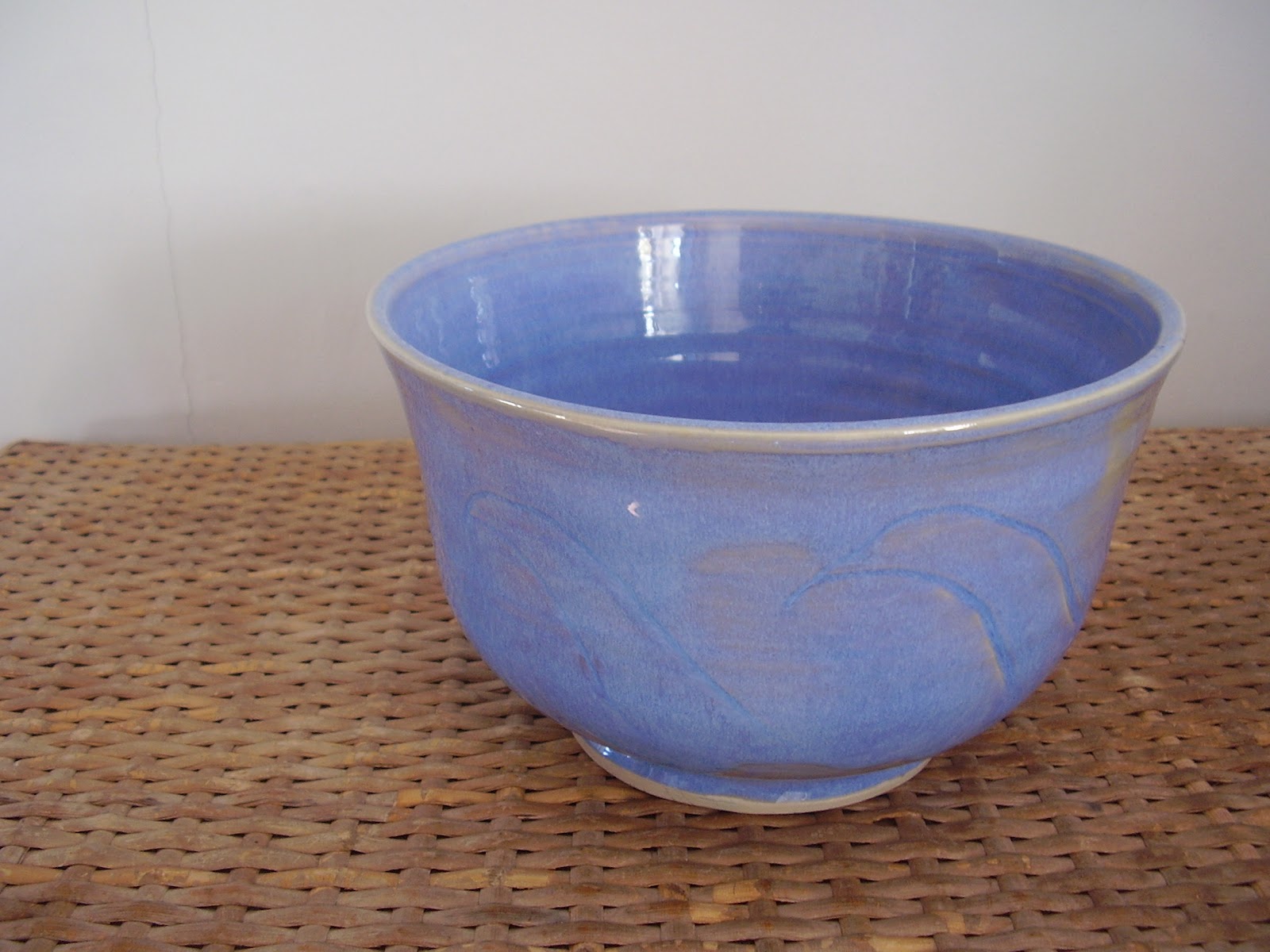
I -- we -- like to show the good pots, the successful results. For me, at least, there are plenty of mistakes along the way. Some mistakes come in the process of learning something new. Some come from pure stubborn insistence on doing something that doesn't work. Some, who knows?
So here are some of my recent failures.
I'm learning about cone 5-6 firing, messing up as I go. For the non-potters among you, this is an intermediate temperature to fire glazes onto pots, requiring clays and glazes that fit this temperature. I'm using commercial glazes still at this temperature, some from very old batches given to me by a friend who hasn't used them in years.
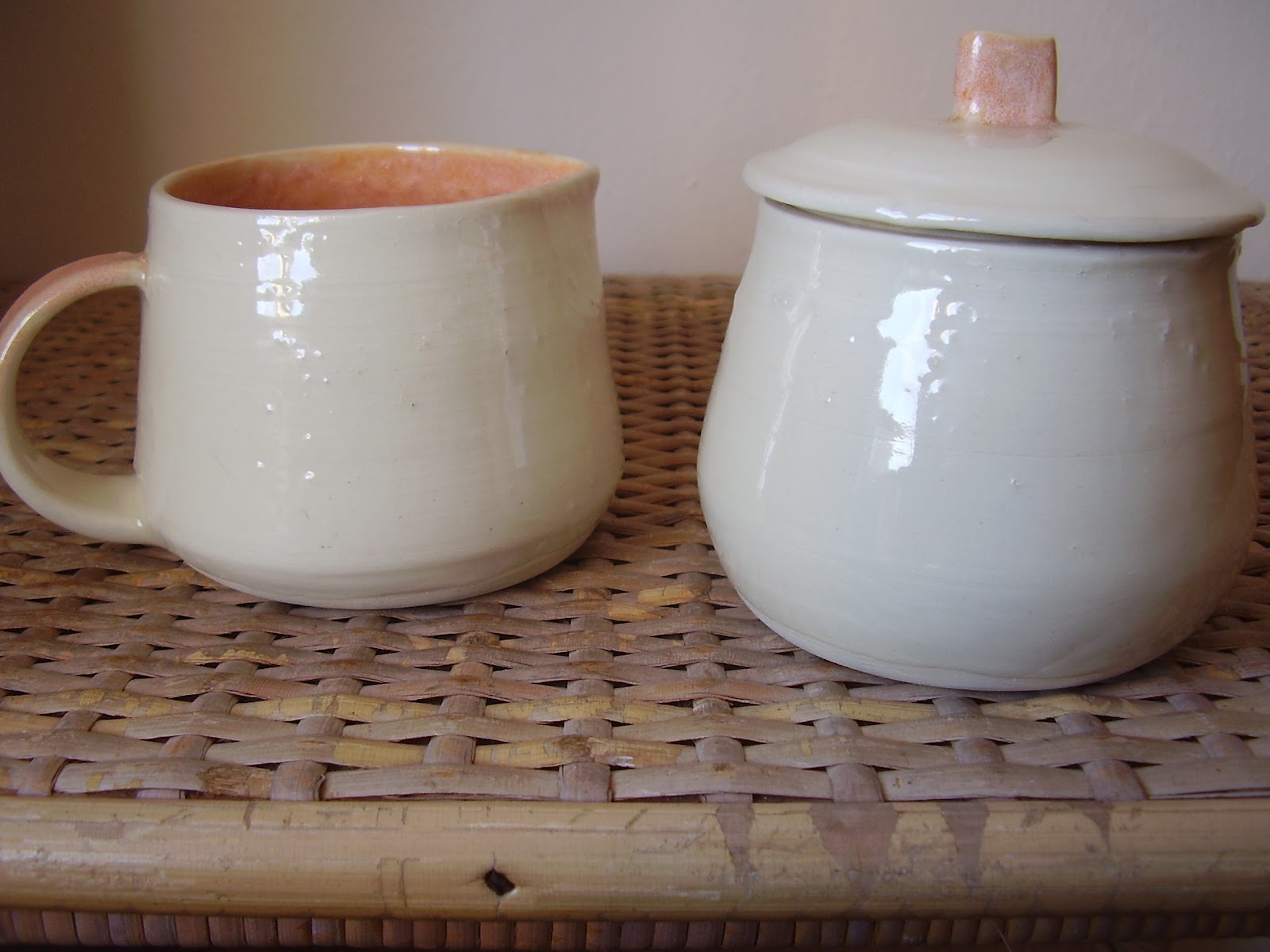
That's a commercial clear glaze, and yes it says to fire at cone 6. I fired this kiln load cone 5, about 50 degrees cooler, never imagined it would make a significant difference. It does, full of bubbles. Refired at cone 6, on these pieces, the glaze is much better..
Here's an old glaze, bubbled, cratered, and ugly. Not much improved by refiring.
Oh, and you can only use stilts at low temperature firing I guess. I tried to hold this lid above the kiln shelf with a stilt, sunk so thoroughly into the otherwise lovely cone 6 glaze that it is still and forever there.
When the pot is thin (a success, for me) and you put a second layer of glaze on before the first is completely dry, the glaze saturates the pot and
runs off in the firing. I try to consider it tuition, for the lesson.
Porcelain clay and sharp corners are a problem combination. Yes, it works sometimes, don't know what makes the difference.
And when you refire to try to fix glaze mistakes, sometimes it works. Sometimes, the clay (B mix especially, I learn) bloats in spots.
Didn't fix the bubbling, either.
Often I have no idea why problems show up. Why did this warp, when many similar sponge holders came out fine?
Or these bowls, the same glaze on same clay, the lighter yellow on the top kiln shelf, the darker on the next 1/2 shelf down. How much difference can there be in temperature or air flow?
Is there anything better than whining here?
Learning, clearly, which costs failure, among other things.
At times, a good discovery. I like those 2 yellow glaze effects, and perhaps can discover how to get both results reliably.
I usually choose to make smooth surfaces. Textures often result from a bumped pot or a slip with a trimming tool, that ruin the pot unless I can turn the mistake into something decorative. Here's one that worked.
There's an old technique from creativity trainer Edward de Bono, which he called "a PMI". He suggested you never give up on a failed idea without "doing a PMI". This means looking for the
Plus: what's good about it?
Minus: what's bad about it?
Interesting: what else does it suggest?
The first two points are for learning; the last one is where the creativity come from.
Saturday, May 26, 2012
Monday, May 14, 2012
Next sale: the North Park Festival of the Arts
Hello.
I and pots will be at the North Park Festival of the Arts, Sunday May 20, 10-6. Somewhere"near the main stage"; that's all the information I have so far. Come by, have a look.
Wednesday, April 4, 2012
Do You Know About the Empty Bowls Project?
It's an ongoing fundraiser, local but in many places, for services for hungry and homeless people. Potters donate handmade soup bowls, restaurants and bakeries donate soup and bread, sometimes musicians donate performances; and anyone interested comes to lunch or dinner, makes a donation, chooses a bowl, and fills it with food. You keep your bowl. Check out emptybowls.net.
I know of 2 Empty Bowls events in San Diego this spring:
Coronado High School on April 19
La Jolla Methodist Church on May 12.
I've heard wonderful stories from the potters' perspective, about people choosing their bowls. There are all sorts of bowls donated, ones you like, ones you hate. But there's the story of the little boy grumping through the entry line, until he found the bowl with the dinosaur carved into it; then it was his event. Or the little girl delighted with a bowl with a big red heart, that no adult would touch.
Something for everyone. But is everything for someone? I am fascinated and always surprised at the things people choose, from the pots I offer for sale, or from the huge selection at UCSD Craft Center sales. Why do you like that? As I work more in pottery, I am coming to see why I like this. But other people's taste? A great variety, clearly, and marvelously mysterious.
There are people who donate 100 bowls. I've got 6 drying. Oh, well. But many potters in San Diego participate. It's a lovely project to get your hands into.
Tuesday, March 27, 2012
New pots! So much fun to see what's turned out!
Preparing for the Rolando Street Fair, I've been hustling to finish and fire pots. So I've suddenly got all these new pieces. Like opening presents, the full range from wonderful to, ew, how did it do that? Here are some goodies, just for the pleasure of sharing my pleasure.
The red/purple cups are high fired, cone 10, one of my favorite glazes. The brown one is an experiment, cone 5, a temperature range I am just learning about.
Some more favorite glazes, cone 10.
Surprises, always. The yellow bowls were made with the same clay, same glaze, same firing. The lighter ones were on the top shelf of the kiln, the darker ones on the half shelf below. What makes the difference, anyway?
Pottery is one of those big subjects. There will always be more to learn. Hurray!
The red/purple cups are high fired, cone 10, one of my favorite glazes. The brown one is an experiment, cone 5, a temperature range I am just learning about.
Some more favorite glazes, cone 10.
Surprises, always. The yellow bowls were made with the same clay, same glaze, same firing. The lighter ones were on the top shelf of the kiln, the darker ones on the half shelf below. What makes the difference, anyway?
Pottery is one of those big subjects. There will always be more to learn. Hurray!
Thursday, January 26, 2012
Developing an Idea
Last May, at a pottery street sale in England I saw ceramic whiteboards for sale. Whiteboards? Noteboards? About 6"x 9" ceramic slabs, like tiles, which you can write on with dry erase markers and eraser. I never imagined the possibility, assumed the usual commercial whiteboards were some special material. I asked the maker for permission to copy her idea, and promised to sell them only 6000 miles away. She agreed, and I've been trying them.
First, low fire white clay so the boards are less likely to warp than clay in a higher temperature firing. I tried 2 clear glazes, one clearly came out smoother. That's it. The potter I am copying from makes ocean inspired pieces, so stamped shell figures on her noteboards. She hangs the boards from rough string. I'd like it somewhat fancier, and I have an idea and materials from decorated jars I have been making. Like this:
So instead of string, I used fabric ribbons and beads to hang the boards. I imagined them on dorm room doors. Here's the first fairly successful result:
Fairly successful? Not a wonderful stamp and the picture takes up a fair amount of the writing surface. Try a smaller, more elegant decoration. Round the corners.
It's more or less smooth and I assume the surface needs to be smooth. I shaped it with a slab roller. Oops, got to be really careful that the plastic surface underneath is smooth. It's also about 1/4" thick and rather heavy for the size. So try thinner. I rolled some on drywall, with a rolling pin, without plastic in between, for a very smooth surface. Some came out fine, some stuck to the drywall, can't pry it off even when dry. No idea what makes the difference. I cut a rectangle, rolled some more and got a very uneven edge. I like it.
Lighter in weight, they can be a bit bigger; that's more useful. Skip the stamps altogether, they seem fussy. Use more interesting beads.
This is where I am now. I've rolled some on plywood, like the faint wood pattern, though I don't know if the writing will be clear. Forget the drywall. What instead? Silicone sheets? Paper? The wood pattern suggests a light wood color. Maybe they don't have to be white.
For me, an idea develops like this. I have seen artists' notebooks with a developmental series of sketches. I've seen pots with designs planned out carefully and sketched on the pot in pencil. I am more inclined to try something I've seen and liked, then vary it by intent or mistake or what comes out. One outcome suggests another variation. Technically described, there are several kinds of (or ways to) creative thinking. Mine seems to be this, putting together elements from disparate sources, in a varying, wandering way.
First, low fire white clay so the boards are less likely to warp than clay in a higher temperature firing. I tried 2 clear glazes, one clearly came out smoother. That's it. The potter I am copying from makes ocean inspired pieces, so stamped shell figures on her noteboards. She hangs the boards from rough string. I'd like it somewhat fancier, and I have an idea and materials from decorated jars I have been making. Like this:
So instead of string, I used fabric ribbons and beads to hang the boards. I imagined them on dorm room doors. Here's the first fairly successful result:
Fairly successful? Not a wonderful stamp and the picture takes up a fair amount of the writing surface. Try a smaller, more elegant decoration. Round the corners.
It's more or less smooth and I assume the surface needs to be smooth. I shaped it with a slab roller. Oops, got to be really careful that the plastic surface underneath is smooth. It's also about 1/4" thick and rather heavy for the size. So try thinner. I rolled some on drywall, with a rolling pin, without plastic in between, for a very smooth surface. Some came out fine, some stuck to the drywall, can't pry it off even when dry. No idea what makes the difference. I cut a rectangle, rolled some more and got a very uneven edge. I like it.
Lighter in weight, they can be a bit bigger; that's more useful. Skip the stamps altogether, they seem fussy. Use more interesting beads.
This is where I am now. I've rolled some on plywood, like the faint wood pattern, though I don't know if the writing will be clear. Forget the drywall. What instead? Silicone sheets? Paper? The wood pattern suggests a light wood color. Maybe they don't have to be white.
For me, an idea develops like this. I have seen artists' notebooks with a developmental series of sketches. I've seen pots with designs planned out carefully and sketched on the pot in pencil. I am more inclined to try something I've seen and liked, then vary it by intent or mistake or what comes out. One outcome suggests another variation. Technically described, there are several kinds of (or ways to) creative thinking. Mine seems to be this, putting together elements from disparate sources, in a varying, wandering way.
Wednesday, December 14, 2011
Making pots, making bread
I am deeply involved in these two ancient crafts. Just noticed how many similarities there are between them, when I was given a very unfamiliar bread recipe by a pottery teacher.
Both come straight from the hands. Kneading dough and wedging clay are only slightly different preparation processes, different because you don't want to leave air bubbles in the clay and they are welcome in bread. Bubbles in clay mean air expanding inside the pot wall in the kiln and a crack or explosion. Gas bubbles in bread dough raise the bread.
Both start with a handmaking and end with a baking, a stage when the maker can only adjust conditions and let the processes go on their own.
Clay is only slightly more directly from the earth, dug and processed clay and glaze materials. Bread is basically ground grain, water, yeast. One is geo, one is bio.
Culturally both are world-wide, ancient and as variable as that suggests. So many techniques, traditional and newly invented or rediscovered. The unfamiliar ones seem deeply peculiar, and they all work.
Both bread and ceramics have become industrial products; some of us still make them joyfully by hand, participating in something elemental and human. I love it.
Both come straight from the hands. Kneading dough and wedging clay are only slightly different preparation processes, different because you don't want to leave air bubbles in the clay and they are welcome in bread. Bubbles in clay mean air expanding inside the pot wall in the kiln and a crack or explosion. Gas bubbles in bread dough raise the bread.
Both start with a handmaking and end with a baking, a stage when the maker can only adjust conditions and let the processes go on their own.
Clay is only slightly more directly from the earth, dug and processed clay and glaze materials. Bread is basically ground grain, water, yeast. One is geo, one is bio.
Culturally both are world-wide, ancient and as variable as that suggests. So many techniques, traditional and newly invented or rediscovered. The unfamiliar ones seem deeply peculiar, and they all work.
Both bread and ceramics have become industrial products; some of us still make them joyfully by hand, participating in something elemental and human. I love it.
Thursday, November 3, 2011
Why "The Village Potter?"
What is a potter anyway, in the 21st century?
Making pots has been a useful craft for maybe 12000 years, providing utilitarian, ceremonial, elegant and fun products for local use and trade. Ceramics may really be the oldest profession. There's a long, widespread set of traditions behind us, sometimes simple, sometimes extremely sophisticated. Does that matter much to potters now?
The traditions give us many ways to do every part of the process of pot-making. We tend to learn how to do it "right" and then expect that our way is the way -- just like any other skill, knowledge, cultural practice. I found it a great shock to discover a Japanese tradition in which -- impossible! -- people turn the wheel the opposite direction! I bet that sounds silly to non-potters; what difference can it make? It makes several technical differences, but mostly, it's not the way we do it! Not the way our hands have learned so well and automatically that it feels natural.
Potters often say there are no new ideas; sure, copy what you see. With centuries of work at our backs, there are more ideas out there than we'll ever have time to try. Do we need new ones? Can't help coming up with new ones? Find the fun in new ones? Do we value the traditional?
We stand in a historic and prehistoric line of traditional hand producers and a world-wide community of interest. Archeology is us! Literally, we can make archelology. Pottery traditions vary so much that archeologists use the variations to track cultural changes, ranges, contacts. And there is an increasing linkage of contemporary craft makers to archeologists, to work out the processes that produced what archeologists dig up. Sure we can show you how they made those Moche pots.
Personally I love the traditional anchor of the craft, though I rarely make very traditional pots. I do copy, more or less, interesting pots I've seen. I meant to be an archeologist, until I found out how much patience it takes.Over the years since, I've made several forays back towards archeology; making pots is definitely one of them.
Still, most potters now are not old-style craft makers whose work is needed by their communities. The continuing traditionalists, the revivers of old traditions (Pueblo potters, for example), and contemporary ceramic makers are now categorized more as artists, ceramists. Many really are sculptors, perhaps using traditional or functional forms as a jumping off place. Beautiful, symbolic or inventive pots have their place in collections and museums as well as kitchens and gardens. I am uncomfortable considering myself an artist, though I do see that I follow up ideas that attract me. Does it mean we should have art training first? Try for individual expression rather than service to a community? Relate only to the appreciated few people who want handcrafts in their daily lives? Concern ourselves more with beauty and invention and not with function? Is craft necessarily art these days? Low art?
We do distinguish studio pottery from industrial ceramic production and think handcraft has different value than the factory produced wares.And there is still a small niche for production potters, people who hand make on a small mass scale -- dishes for a restaurant, favors for a wedding, in my area Mexican garden pots.
I am unsettled about all these points. I would like to be the village potter in the 21st century, and am still working on what that means. If you want to talk about any of this, please write. I'd love to talk with you.
Making pots has been a useful craft for maybe 12000 years, providing utilitarian, ceremonial, elegant and fun products for local use and trade. Ceramics may really be the oldest profession. There's a long, widespread set of traditions behind us, sometimes simple, sometimes extremely sophisticated. Does that matter much to potters now?
The traditions give us many ways to do every part of the process of pot-making. We tend to learn how to do it "right" and then expect that our way is the way -- just like any other skill, knowledge, cultural practice. I found it a great shock to discover a Japanese tradition in which -- impossible! -- people turn the wheel the opposite direction! I bet that sounds silly to non-potters; what difference can it make? It makes several technical differences, but mostly, it's not the way we do it! Not the way our hands have learned so well and automatically that it feels natural.
Potters often say there are no new ideas; sure, copy what you see. With centuries of work at our backs, there are more ideas out there than we'll ever have time to try. Do we need new ones? Can't help coming up with new ones? Find the fun in new ones? Do we value the traditional?
We stand in a historic and prehistoric line of traditional hand producers and a world-wide community of interest. Archeology is us! Literally, we can make archelology. Pottery traditions vary so much that archeologists use the variations to track cultural changes, ranges, contacts. And there is an increasing linkage of contemporary craft makers to archeologists, to work out the processes that produced what archeologists dig up. Sure we can show you how they made those Moche pots.
Personally I love the traditional anchor of the craft, though I rarely make very traditional pots. I do copy, more or less, interesting pots I've seen. I meant to be an archeologist, until I found out how much patience it takes.Over the years since, I've made several forays back towards archeology; making pots is definitely one of them.
Still, most potters now are not old-style craft makers whose work is needed by their communities. The continuing traditionalists, the revivers of old traditions (Pueblo potters, for example), and contemporary ceramic makers are now categorized more as artists, ceramists. Many really are sculptors, perhaps using traditional or functional forms as a jumping off place. Beautiful, symbolic or inventive pots have their place in collections and museums as well as kitchens and gardens. I am uncomfortable considering myself an artist, though I do see that I follow up ideas that attract me. Does it mean we should have art training first? Try for individual expression rather than service to a community? Relate only to the appreciated few people who want handcrafts in their daily lives? Concern ourselves more with beauty and invention and not with function? Is craft necessarily art these days? Low art?
We do distinguish studio pottery from industrial ceramic production and think handcraft has different value than the factory produced wares.And there is still a small niche for production potters, people who hand make on a small mass scale -- dishes for a restaurant, favors for a wedding, in my area Mexican garden pots.
I am unsettled about all these points. I would like to be the village potter in the 21st century, and am still working on what that means. If you want to talk about any of this, please write. I'd love to talk with you.
Subscribe to:
Posts (Atom)