Tuesday, November 15, 2016

Are You the Potter Who is Giving Cups Away?

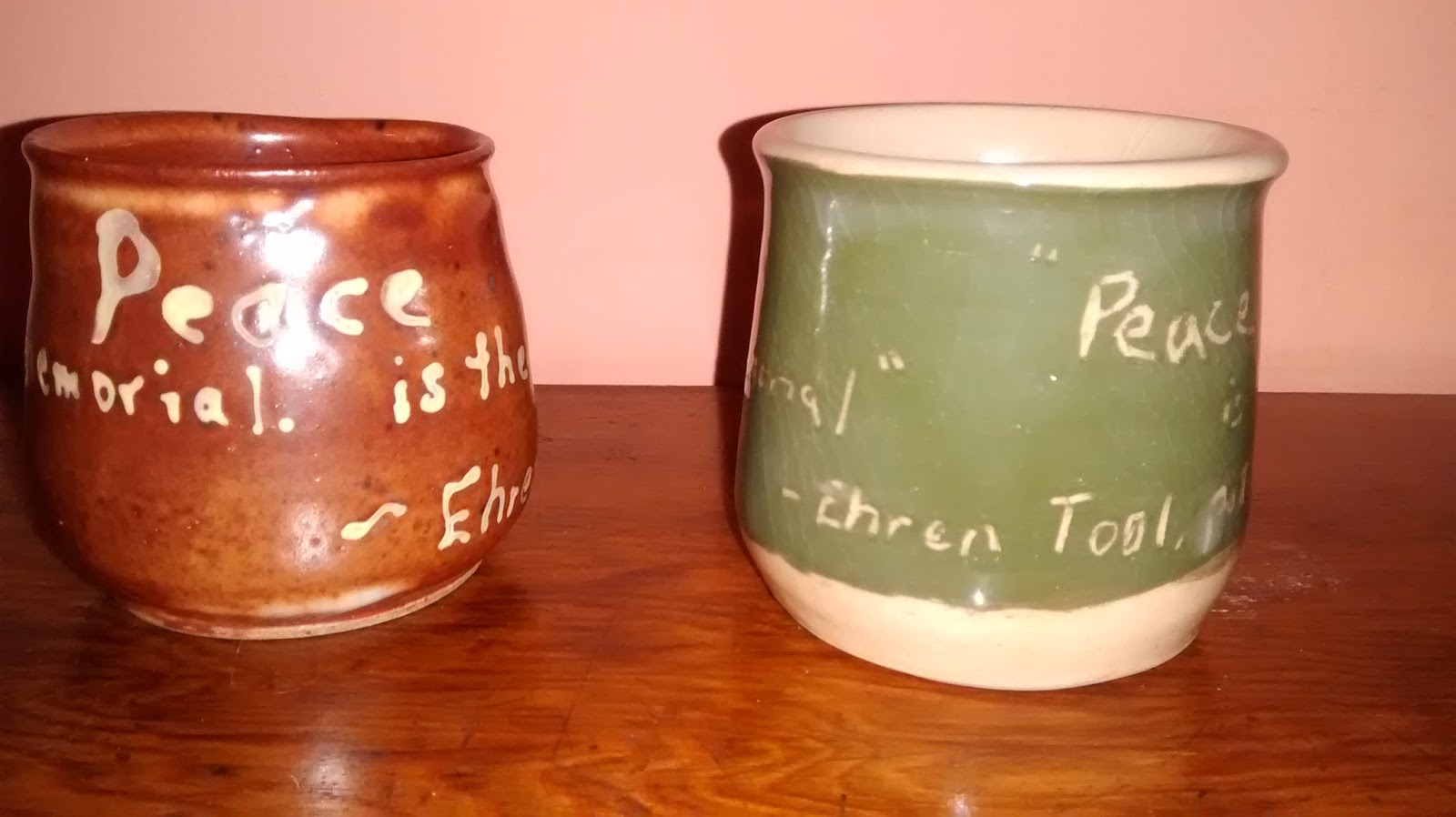
For a few months I have been making and giving away cups, in response to Ehren Tool's long-term project of making cups for/with veterans. He makes them with images from soldiers' combat memories and gives them away.  He is up to some 14000. I have made maybe 25, carved with a ubiquitous statement of his: peace is the only adequate war memorial.

 Just starting, and beginning to learn how people react to the offer of a cup. Besides giving cups to family and friends, I have offered them at 2 craft sales.


Most people seem to need an explanation, of the cup, or of the offer. They do not stand alone as a cup, a message, or an offer. Usually people want an answer to "why are you offering these?" Perhaps, in the context of selling, the gift is too odd to accept easily.

Some people have felt guilty at accepting something free, and have bought another pot from me, out of guilt rather than liking. I don't get it.

One woman returned later, having gone to her car to bring me a return gift, a lovely small book of Buddhist advice which she kept in the car for her use. I think that's fellow-feeling, not guilt. I appreciate it; I read it.

One man stayed to tell me at length what he does to support veterans. I'm very pleased; it was not at all clear to me that my project would be seen as supportive of anyone. 

So cups lead to conversation, and that seems to me a fine thing. Someone really did come by my booth at a sale, several hours after the cups were taken, to ask if I am the potter who is giving cups away. In some way these cups are an invitation to expand on the offer, to continue with whatever attracts people to them. I am reminded of one of the pleasures and products of these sales, an openness for me and the customers to what comes up, an availability, an invitation. It's not just selling, and not just the "stuff". I started making and offering cups because Tool's message and project spoke to me. Now I am seeing them attract other people in their own ways.


Tuesday, November 1, 2016

Upcoming Sales and Pots

Ready to think of Christmas presents? Ouch.

I'll be at 3 very different craft/art sales this month.

November 16-17 all day; a sale to raise funds for the ceramics program at ECC (community college branch), at Educational Cultural Complex near 805 and Imperial;
     very variable quality, including flower arrangements and potted succulent gardens, very low prices

November 19, 9-3, at Lindbergh Schweitzer Elementary School near 805 and Balboa;
     a homey, friendly, not fancy craft sale

November 20,  Talmadge Art Show, 10-4, at the Liberty Station Conference Center;
     very classy craft products


Monday, October 17, 2016

And... A Flop

Sometimes it sure doesn't work.

This is by far the best of a batch of new pots. I do like it, form, glaze, weight, feel.


But it cracked, thoroughly. No use.


Now what? I think of  Edward de Bono's recommendation from years ago, to "do a PMI". It means "plus", "minus", "interesting". Mostly it means, don't toss something disappointing without learning from it. First check the plus in it: what's good; the minus: what's bad; the interesting. And, I add, why for each of those.

What's good? The above, also the size is right for handling and use. The glaze came out interestingly variable, and where do those wonderful little red speckles come from? The texture shows. I didn't realize the glaze would look so good on this clay. The iron spots actually add to the interest.

What's bad? The crack, for sure, Why did it crack, anyway? Some stress on the side where the crack starts. I pushed the clay hard into the mold to get it thin everywhere. It's not thinner where it cracked, nor thicker, not patched...but something . Is anything else bad? I sure didn't think to consider that. Well, it could be lighter in weight. Do I dare make the clay slab thinner with this much overhang?

Think I've covered interesting, but I'm also getting interested in the problem. Why did it crack? Think I'll keep the pot awhile, show it around, ask what others think of this. So far, I have no idea.

I'd rather make successful pots, of course, but mistakes in pottery count for very little. No one is hurt, and there are always more pots in clay, glaze, and hands.

Thursday, September 29, 2016

How Complicated Do Tou Want It To Be?

Ceramics is one of the BIG fields. There seems no end to things to learn, to variants, techniques, forms, designs... . No one gets bored, no one comes to the end.

Here's one technique I am starting to use. You can make a pot from one clay, but why stop there? The world over, people have invented ways to mix clays to produce a patterned clay to pot with. It can be very complicated; you can combine thin, cut slabs of clay of various colors to make pictures that go through a roll of clay, seen when the roll is cut into slices. No way do I want to learn that.

You can stack thin slabs of different colored clays (2 or 3, don't overdo it), throw them hard onto the table to connect and thin them, cut vertically, restack, repeat until done. Then the stacks are sliced and pieces arranged to make patterns, either as a surface over other clay or as the structure of a pot.

It can also be very simple: casually cut slabs of 2 or 3 clays, and wedge (that's knead) them partly together. As you shape a pot on the wheel, the clays combine further and swirl. That's for me.


In English, especially in Britain, this is agate clay, an imitation of agate stone. In Japan, it is nerikome or neriage (the difference between them evidently is the way the pot is made.)

Yes, you have to use clays with similar shrinkage and the same firing temperature, to be sure the pot holds together. Yes, you need a lot of contrast among the colors; two differently colored stonewares will do it, or a clay in sections colored differently by wedging in stains or oxides. Yes, the pot does take a lot of trimming, scraping, sanding to show the clay swirl clearly. And different amounts of wedging the colors together produce quite different results.


This comes from combining the clays less. I think I like it better with a tighter swirl. And without glaze, like the bottom of this vase.


Even the simplest version of this technique involves complications and alternatives. It's all wonderfully endless.

Friday, September 16, 2016

Want to See Something Gorgeous?

I've drooled over Alan and Brenda Newman's pots for several years now. I found them at The Real Mother Goose galleries/stores in Portland, Oregon. Finally I bought one. Look!


So delicate, so elegant, so cool, so convincing. Wow!

Many years ago, near the beginning of my learning pottery, I saw a small bowl at a UCSD Craft Center sale, and thought, if I can make that, I'll be happy. It was thin and graceful, white with a light spray of green at the rim. Delicate, elegant, cool, convincing. I think I can make a bowl like that now. Think I'll do it. And I will be happy. And I also expand my ambitions. No way can I make anything like this goblet now. That'll probably take another decade.

Its only flaw is practical, and it is so beautiful I'm not sure that matters. It's a pot worth keeping just to look at. But it is hard to wash, with that narrow, deep end to the cup.


Want to see some more of their fabulous work? newmanceramicworks.com

Sunday, August 28, 2016

What a glaze! and a mystery

I've always thought of ohata kaki as one of my favorite glazes. It's a Japanese glaze and name; some part of it means persimmon. It's usually brown, though, in my experience, with a warm orange undertone. Like this:


It's a lovely glaze to work with too; it covers evenly, it doesn't run, and it is spectacularly easy to clean. Everything washes easily off this casserole dish.


Recently, and mysteriously to all involved, pots have been coming out like this


at the shared studio where I take classes. Warm, glossy, orange with depth and a brown undertone. Hmmmm. Any explanations? Pottery is one of those big fields, where there's no end to things to learn and ways to improve and discover. Wonderful.

Monday, August 15, 2016

Peace is the Only Adequate War Memorial: Trying it Out

I was much moved by Ehren Tool's long term project of making cups for and then with veterans about their war experience, by and his much-quoted statement: "peace is the only adequate war memorial." In response to his work, I have started making cups with these words on them, and, following his example, giving them away.


(Yes, I notice this is not peace-making, or at most a very modest and indirect effort in that direction.)

Yesterday I tried this out for the first time, offering cups at the Art in the Village event in Carlsbad, CA. All were taken within the first hour of the sale. People like it, I can tell that. There is a lot more I do not yet know:

The whole plan took explaining, repeatedly; so I suppose I need a poster explaining who Tool is, what he does, how I am responding and how those who take a cup participate.

Even though we were one town away from a Marine base, only one of the recipients seems to be a veteran. The others are just people, mostly women.


So what do they want one of these cups for?  Just a free cup? For some people, I think so; they thought I am surprisingly generous. Some others seemed as touched by Tool's message as I am; the cup is expressive for them too.

Do I care why they wanted a cup? Is it any of my business?

Why do I make them and offer them? I do it to honor Tool, and his project, and to say and spread this message. None of that is about the recipients and what they do. My business is only to make and offer cups. How very simple.