Monday, June 10, 2013
What Makes These So Beautiful?
I think these are gorgeous pots. They were made a few years ago by Irina Davidovich, from San Diego. What is so wonderful about them?
A couple of weeks ago, I was at the Contemporary Ceramics Gallery in London, where there are always fine pots. This year, I saw a lot of heavy, chunky forms and bright painted decoration. Not my taste; I am struck again by the range in taste among potters -- applies too to any other field -- who make things considered good in quality. It's easier to identify technical quality, though sometimes people prefer effects that look less skilled than they can produce. OK, these two pots are clearly skilfully made; beyond that they are wonderful.
For me it is their delicacy and subtlety that stand out. They are about 3 inches high, made of translucent porcelain, feather light. They are mold made, which produces the side seams. For most people, molds are for reproducing a shape many times, quickly. These pots are slightly different from each other.
Both glazes used are almost the color of the clay, which shows unglazed around the outside edge of the bottom.
Inside is a clear gloss. Outside is something marvelous, with a pearly satin finish, and slight amount of color.
So the color range is very subtle. The forms are similar and simple. Within that narrow range, there is a great deal going on. Different amounts of shine and color. Different shapes. It would be possible, even usual, to sand the seams flat and smooth the top and bottom edges to make a finished-looking piece. Here those rough parts are left, contrasting with the smooth sides and elegant form. Without them, these would be much less interesting pots.
Would you use them for something beyond themselves? No, too fragile, and even too rough. They are art, a delight to look at and handle.
Tuesday, April 30, 2013
New Pots, Always Fun!
And yes, all fired at home in cone 6 oxidation. And, I like the results. Progress!
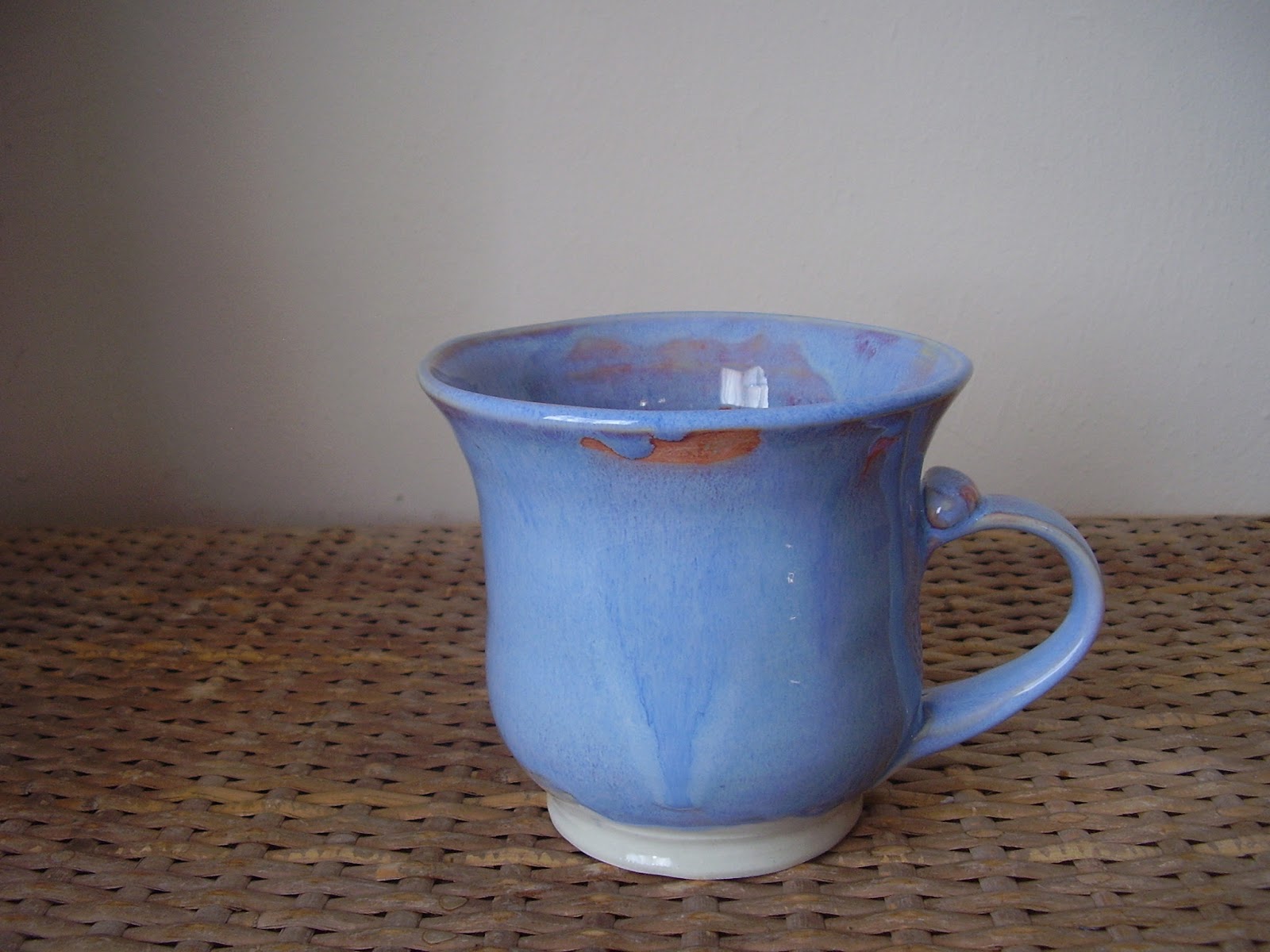
This blue is going to stay as one of my favorite glazes. I love the way it runs, but clear glaze near the bottom -- it really runs.
I tried to get a mixed blue/purple on these but made the blue too thick and the red too thin; the details matter.
Definitely another favorite glaze. It shows the iron spots in speckled clay wonderfully. Why the white/blue drippy effect? No idea.
Several months ago, at the Norton Simon Museum, we found these gigantic sycamore leaves, and I, of course, saw pots in them. About a foot across, and the real leaf, except for the veins. Those I drew, looking at a real leaf.
And a big fig leaf from our tree. I like the realistic leaves, though there is no reason pots need to be real leaf forms. I guess those are just very attractive shapes in themselves.
Here's another leaf shape, used unrealistically. These are patterned on a nasturtium leaf from our yard. Little plates, for tea bags or as a spoon rest, or whatever you think of. Someone told me she needed a small plate for her retainer! And another way around the loss of the UCSD Crafts Center: I've missed the glaze sprayer, been unwilling to buy an air compressor just for this use. But there is a small mouth blown (blow hard!) sprayer for small amounts of sprayed glaze, ok just for effect over glazes applied some other way.
I love this field. There's no end of things to discover and learn.
This blue is going to stay as one of my favorite glazes. I love the way it runs, but clear glaze near the bottom -- it really runs.
I tried to get a mixed blue/purple on these but made the blue too thick and the red too thin; the details matter.
Definitely another favorite glaze. It shows the iron spots in speckled clay wonderfully. Why the white/blue drippy effect? No idea.
Several months ago, at the Norton Simon Museum, we found these gigantic sycamore leaves, and I, of course, saw pots in them. About a foot across, and the real leaf, except for the veins. Those I drew, looking at a real leaf.
And a big fig leaf from our tree. I like the realistic leaves, though there is no reason pots need to be real leaf forms. I guess those are just very attractive shapes in themselves.
Here's another leaf shape, used unrealistically. These are patterned on a nasturtium leaf from our yard. Little plates, for tea bags or as a spoon rest, or whatever you think of. Someone told me she needed a small plate for her retainer! And another way around the loss of the UCSD Crafts Center: I've missed the glaze sprayer, been unwilling to buy an air compressor just for this use. But there is a small mouth blown (blow hard!) sprayer for small amounts of sprayed glaze, ok just for effect over glazes applied some other way.
I love this field. There's no end of things to discover and learn.
Saturday, April 13, 2013
Form and the Details that Matter
I've been developing a shape for jars or casseroles (same thing, choose your use). It's shape that attracts me to pots, more than color even, and far more than decoration.
I do not have much education in art or aesthetics, and so am not sure who knows this or can jump right to the best form. For me, it is often a surprise or discovery to find a good form. I think as I become a more skilled potter, I am improving both in hand and eye.
This was the first pot in this shape. I like the handle and the rolled rim of the pot. Otherwise, kind of boring.
When it comes out well, the handle really swirls. It's light, simple and loose, and very practical --just what I like.
Ah, better when the sides slope in, on both pot and lid. The rim has a lift to it too. I'm not sure if that's as good as the rolled edge.
OK. This is it. The sloping sides, the lifted rim, the and a continuous line from pot sides up the sides of the lid. Still having trouble getting those lids to sit evenly on the pot.
This one worked well. And a safe glaze that should look good with food.
I do not have much education in art or aesthetics, and so am not sure who knows this or can jump right to the best form. For me, it is often a surprise or discovery to find a good form. I think as I become a more skilled potter, I am improving both in hand and eye.
This was the first pot in this shape. I like the handle and the rolled rim of the pot. Otherwise, kind of boring.
When it comes out well, the handle really swirls. It's light, simple and loose, and very practical --just what I like.
Ah, better when the sides slope in, on both pot and lid. The rim has a lift to it too. I'm not sure if that's as good as the rolled edge.
OK. This is it. The sloping sides, the lifted rim, the and a continuous line from pot sides up the sides of the lid. Still having trouble getting those lids to sit evenly on the pot.
This one worked well. And a safe glaze that should look good with food.
Tuesday, March 19, 2013
Not a word
for 2 1/2 months. I didn't even notice. Sorry, for anyone who is reading. It's been a time to focus on people dying.
Monday, December 31, 2012
Not So Bad After All
Since the much lamented closing of the UCSD Crafts Center, I have been mourning it, deciding it is high time to learn mid-temperature oxidation firing (which I can do at home), buying clay and glazes for that temperature, and trying, with test pots. And so I discover what I suppose is the usual lesson: it's not so bad after all!
I find I like being in control of the whole process, instead of sharing the firing under other people's management. I feel I know better what I am doing and choosing. I've found some wonderful new glazes and glaze combinations. Eventually, as I find my way, I expect I'll mix my own glazes.
And I've made some decent pots in this way.
Onward!
I find I like being in control of the whole process, instead of sharing the firing under other people's management. I feel I know better what I am doing and choosing. I've found some wonderful new glazes and glaze combinations. Eventually, as I find my way, I expect I'll mix my own glazes.
And I've made some decent pots in this way.
Onward!
Tuesday, November 27, 2012
TheHoliday Hit List
I'm participating in the Holiday Hit List, a craft sale December 2, at Liberty Station.
Address: 2710 Historic Decatur; that's the corner of Decatur and Dewey. Take Dewey south off Rosecrans 2 blocks.
Time: noon to 6 pm. We're mostly inside, so rain or shine.
Here's my latest. It's a Christmas sale, I guess, but I'm still thinking fall.
Address: 2710 Historic Decatur; that's the corner of Decatur and Dewey. Take Dewey south off Rosecrans 2 blocks.
Time: noon to 6 pm. We're mostly inside, so rain or shine.
Here's my latest. It's a Christmas sale, I guess, but I'm still thinking fall.
Saturday, October 27, 2012
Losing the UCSD Crafts Center
The Crafts Center closed suddenly during registration for fall classes this month. The funding was pulled, and we all sat stunned. I've learned to make pottery there, have been taking classes for almost 7 years. Wow.
In some ways, it was well done. The Center is funded by UCSD student fees and by tuition for classes and studio membership. Prices rise, university budget falls, the students do not want to pay more in fees. In a poll of students' priorities for the use of their fees, the Craft Center came out low. And it is hard to argue that teaching crafts is so central to a university's work that they must find alternate funding.
But so suddenly? With no warning and no chance for all the people who love the place to work to fill the financial gap? And at this time, after course flyers were produced and distributed, and registration underway?
Individually, we who work there are forced to a decision point. This is not a bad thing -- how do we see ourselves as craftspeople? what will we do next, since we will not do what we are used to? how much commitment will we make to finding resources to continue in our crafts? Some have already moved to other studios, decided to work alone at home, or quit. I feel kicked out of the nest, required to fly. I think it may be high time for that, good for me. I have been exploring the kind of mid-temperature firing I can do at home, but not with much energy. Until I find another shared studio, if I do, it will now be most of my potting..
But I am also mourning my losses, and finding more as the weeks continue after the Center closed. We scrambled to finish partly-done pots, feeling unwelcome in our home away from home. I have a few pots left -- will I find another place to fire cone 10 reduction? Whoa, I don't have access to a slab roller for making a kind of platter I have developed as mine. Like this one:
Oops, no more glaze spraying, no more of these good effects:

What about my favorite glazes? For some I have found lower temperature equivalents, but not for other wonderful ones, like this:
And the unpredictable runny and varying looks that high temperature firing produce; I love them.
But mostly, it's the company I miss, the colleagueship, the easy availability of answers to my questions, the shared familiarity with glazes and kilns, the friendliness, the shared history, the community.
For me, not a tragedy. I can continue at home, and I am not dependent on the Crafts Center for income. But it is real loss.
The university calls it only a temporary closure, though that seems unlikely without ongoing action from those who want to be there. A substantial group of us are organizing to try to continue -- to preserve equipment, raise funds, look for alternative homes in and out of UCSD, increase support among students. I am impressed with the beginnings of this process; it seems thoughtful, careful, realistic, long-term. Wish us luck.
In some ways, it was well done. The Center is funded by UCSD student fees and by tuition for classes and studio membership. Prices rise, university budget falls, the students do not want to pay more in fees. In a poll of students' priorities for the use of their fees, the Craft Center came out low. And it is hard to argue that teaching crafts is so central to a university's work that they must find alternate funding.
But so suddenly? With no warning and no chance for all the people who love the place to work to fill the financial gap? And at this time, after course flyers were produced and distributed, and registration underway?
Individually, we who work there are forced to a decision point. This is not a bad thing -- how do we see ourselves as craftspeople? what will we do next, since we will not do what we are used to? how much commitment will we make to finding resources to continue in our crafts? Some have already moved to other studios, decided to work alone at home, or quit. I feel kicked out of the nest, required to fly. I think it may be high time for that, good for me. I have been exploring the kind of mid-temperature firing I can do at home, but not with much energy. Until I find another shared studio, if I do, it will now be most of my potting..
But I am also mourning my losses, and finding more as the weeks continue after the Center closed. We scrambled to finish partly-done pots, feeling unwelcome in our home away from home. I have a few pots left -- will I find another place to fire cone 10 reduction? Whoa, I don't have access to a slab roller for making a kind of platter I have developed as mine. Like this one:
Oops, no more glaze spraying, no more of these good effects:
What about my favorite glazes? For some I have found lower temperature equivalents, but not for other wonderful ones, like this:
And the unpredictable runny and varying looks that high temperature firing produce; I love them.
But mostly, it's the company I miss, the colleagueship, the easy availability of answers to my questions, the shared familiarity with glazes and kilns, the friendliness, the shared history, the community.
For me, not a tragedy. I can continue at home, and I am not dependent on the Crafts Center for income. But it is real loss.
The university calls it only a temporary closure, though that seems unlikely without ongoing action from those who want to be there. A substantial group of us are organizing to try to continue -- to preserve equipment, raise funds, look for alternative homes in and out of UCSD, increase support among students. I am impressed with the beginnings of this process; it seems thoughtful, careful, realistic, long-term. Wish us luck.
Subscribe to:
Comments (Atom)