Ceramics is one of the BIG fields. There seems no end to things to learn, to variants, techniques, forms, designs... . No one gets bored, no one comes to the end.
Here's one technique I am starting to use. You can make a pot from one clay, but why stop there? The world over, people have invented ways to mix clays to produce a patterned clay to pot with. It can be very complicated; you can combine thin, cut slabs of clay of various colors to make pictures that go through a roll of clay, seen when the roll is cut into slices. No way do I want to learn that.
You can stack thin slabs of different colored clays (2 or 3, don't overdo it), throw them hard onto the table to connect and thin them, cut vertically, restack, repeat until done. Then the stacks are sliced and pieces arranged to make patterns, either as a surface over other clay or as the structure of a pot.
It can also be very simple: casually cut slabs of 2 or 3 clays, and wedge (that's knead) them partly together. As you shape a pot on the wheel, the clays combine further and swirl. That's for me.
In English, especially in Britain, this is agate clay, an imitation of agate stone. In Japan, it is nerikome or neriage (the difference between them evidently is the way the pot is made.)
Yes, you have to use clays with similar shrinkage and the same firing temperature, to be sure the pot holds together. Yes, you need a lot of contrast among the colors; two differently colored stonewares will do it, or a clay in sections colored differently by wedging in stains or oxides. Yes, the pot does take a lot of trimming, scraping, sanding to show the clay swirl clearly. And different amounts of wedging the colors together produce quite different results.
This comes from combining the clays less. I think I like it better with a tighter swirl. And without glaze, like the bottom of this vase.
Even the simplest version of this technique involves complications and alternatives. It's all wonderfully endless.
Thursday, September 29, 2016
Friday, September 16, 2016
Want to See Something Gorgeous?
I've drooled over Alan and Brenda Newman's pots for several years now. I found them at The Real Mother Goose galleries/stores in Portland, Oregon. Finally I bought one. Look!
So delicate, so elegant, so cool, so convincing. Wow!
Many years ago, near the beginning of my learning pottery, I saw a small bowl at a UCSD Craft Center sale, and thought, if I can make that, I'll be happy. It was thin and graceful, white with a light spray of green at the rim. Delicate, elegant, cool, convincing. I think I can make a bowl like that now. Think I'll do it. And I will be happy. And I also expand my ambitions. No way can I make anything like this goblet now. That'll probably take another decade.
Its only flaw is practical, and it is so beautiful I'm not sure that matters. It's a pot worth keeping just to look at. But it is hard to wash, with that narrow, deep end to the cup.
Want to see some more of their fabulous work? newmanceramicworks.com
So delicate, so elegant, so cool, so convincing. Wow!
Many years ago, near the beginning of my learning pottery, I saw a small bowl at a UCSD Craft Center sale, and thought, if I can make that, I'll be happy. It was thin and graceful, white with a light spray of green at the rim. Delicate, elegant, cool, convincing. I think I can make a bowl like that now. Think I'll do it. And I will be happy. And I also expand my ambitions. No way can I make anything like this goblet now. That'll probably take another decade.
Its only flaw is practical, and it is so beautiful I'm not sure that matters. It's a pot worth keeping just to look at. But it is hard to wash, with that narrow, deep end to the cup.
Want to see some more of their fabulous work? newmanceramicworks.com
Sunday, August 28, 2016
What a glaze! and a mystery
I've always thought of ohata kaki as one of my favorite glazes. It's a Japanese glaze and name; some part of it means persimmon. It's usually brown, though, in my experience, with a warm orange undertone. Like this:
It's a lovely glaze to work with too; it covers evenly, it doesn't run, and it is spectacularly easy to clean. Everything washes easily off this casserole dish.
Recently, and mysteriously to all involved, pots have been coming out like this
at the shared studio where I take classes. Warm, glossy, orange with depth and a brown undertone. Hmmmm. Any explanations? Pottery is one of those big fields, where there's no end to things to learn and ways to improve and discover. Wonderful.
It's a lovely glaze to work with too; it covers evenly, it doesn't run, and it is spectacularly easy to clean. Everything washes easily off this casserole dish.
Recently, and mysteriously to all involved, pots have been coming out like this
at the shared studio where I take classes. Warm, glossy, orange with depth and a brown undertone. Hmmmm. Any explanations? Pottery is one of those big fields, where there's no end to things to learn and ways to improve and discover. Wonderful.
Monday, August 15, 2016
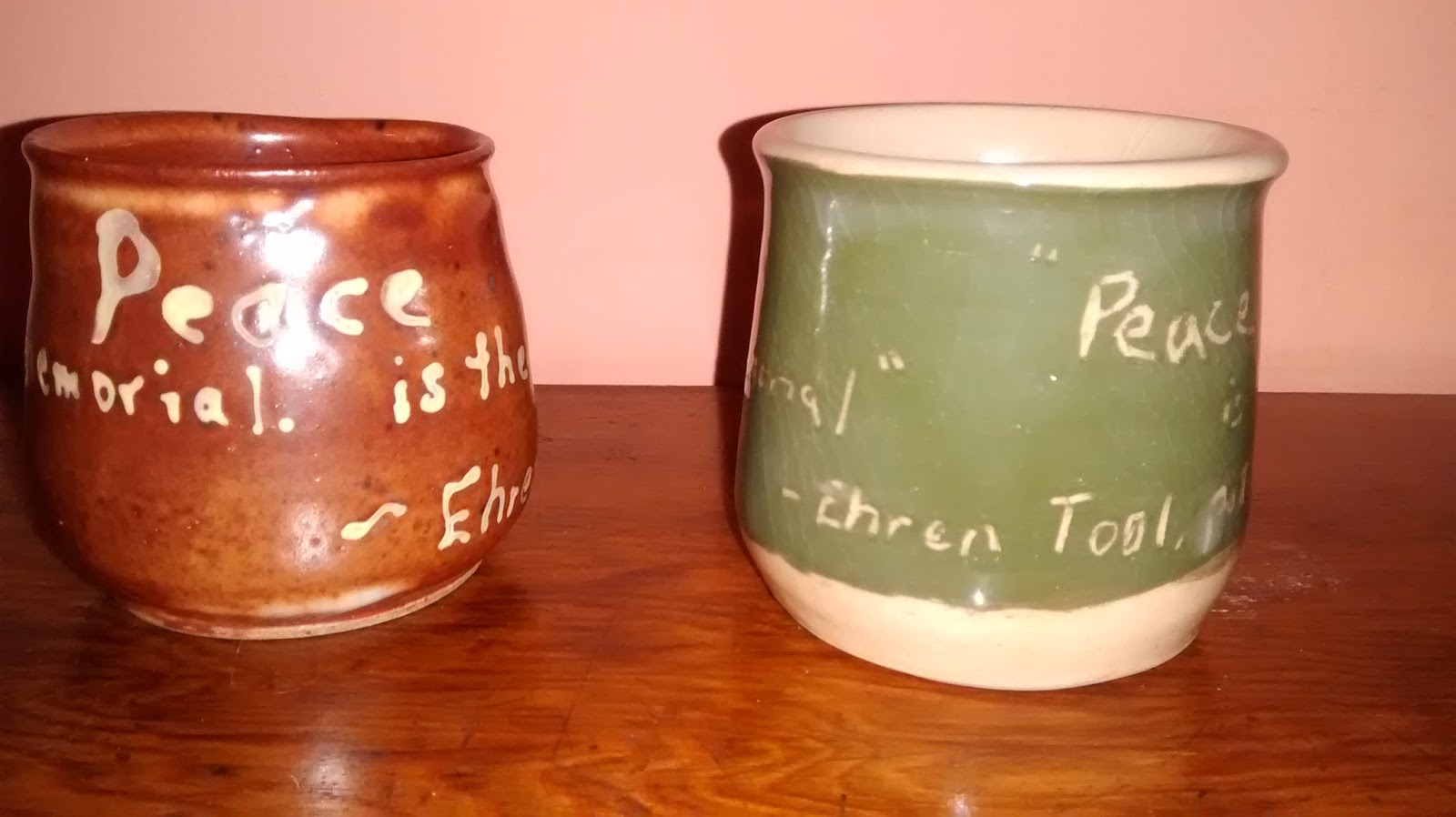
Peace is the Only Adequate War Memorial: Trying it Out
I was much moved by Ehren Tool's long term project of making cups for and then with veterans about their war experience, by and his much-quoted statement: "peace is the only adequate war memorial." In response to his work, I have started making cups with these words on them, and, following his example, giving them away.
(Yes, I notice this is not peace-making, or at most a very modest and indirect effort in that direction.)
Yesterday I tried this out for the first time, offering cups at the Art in the Village event in Carlsbad, CA. All were taken within the first hour of the sale. People like it, I can tell that. There is a lot more I do not yet know:
The whole plan took explaining, repeatedly; so I suppose I need a poster explaining who Tool is, what he does, how I am responding and how those who take a cup participate.
Even though we were one town away from a Marine base, only one of the recipients seems to be a veteran. The others are just people, mostly women.
So what do they want one of these cups for? Just a free cup? For some people, I think so; they thought I am surprisingly generous. Some others seemed as touched by Tool's message as I am; the cup is expressive for them too.
Do I care why they wanted a cup? Is it any of my business?
Why do I make them and offer them? I do it to honor Tool, and his project, and to say and spread this message. None of that is about the recipients and what they do. My business is only to make and offer cups. How very simple.
(Yes, I notice this is not peace-making, or at most a very modest and indirect effort in that direction.)
Yesterday I tried this out for the first time, offering cups at the Art in the Village event in Carlsbad, CA. All were taken within the first hour of the sale. People like it, I can tell that. There is a lot more I do not yet know:
The whole plan took explaining, repeatedly; so I suppose I need a poster explaining who Tool is, what he does, how I am responding and how those who take a cup participate.
Even though we were one town away from a Marine base, only one of the recipients seems to be a veteran. The others are just people, mostly women.
So what do they want one of these cups for? Just a free cup? For some people, I think so; they thought I am surprisingly generous. Some others seemed as touched by Tool's message as I am; the cup is expressive for them too.
Do I care why they wanted a cup? Is it any of my business?
Why do I make them and offer them? I do it to honor Tool, and his project, and to say and spread this message. None of that is about the recipients and what they do. My business is only to make and offer cups. How very simple.
Thursday, July 28, 2016
Art in the Village
August 14th, I'll be at Art in the Village in downtown Carlsbad. Come by.
With new pots, of course.
I'm leaving the clay showing more, as I've got different clay colors to play with. It works.
With new pots, of course.
I'm leaving the clay showing more, as I've got different clay colors to play with. It works.
Thursday, July 14, 2016
New Forms: a Cake Plate Again and French Butter Dishes
New forms are so mysterious I feel again like a little kid, learning huge swaths of the world.
I've been through several iterations of cake stands, learning from each. The latest is actually a best so far.
I'm not a painter and the invitation a flat surface gives, to treat it as a canvas, is a bit beyond me. I like this somewhat loose and abstract thing, but there are a lot of possibilities to explore.
Oops. This was flat; I think the base warped this time. Not sure. Perhaps fixable.
And I've been trying to make French butter dishes. They are a two-part combo, a bowl with water in the bottom, and a reversed container with butter stuffed into it, set into the bowl for a water seal. The idea is to keep butter, safely closed, out of the refrigerator so it is soft.
That took several iterations too, to get to the point I'm at now, one successful dish. What are the proportions that work? Yes, the butter holder needs a flat top so it can be placed open end up for using the butter. How big should that be to sit over the bowl steadily? What looks good? How far is the vertical distance from water bowl base to the ends of the butter holder sides? How do you measure this? How do you visualize it before you've made one? And how to glaze all the parts, so what needs glazing is covered and no touching parts are glazed? For me it's a visual puzzle. Oof.
This one works. It's such a strictly horizontal and vertical construction that the glaze would probably look better with horizontal edges. Hmm.
The next one, on the other hand, never opened; I must have put glaze somewhere where it glued the two parts together.
Ever onward.
I've been through several iterations of cake stands, learning from each. The latest is actually a best so far.
I'm not a painter and the invitation a flat surface gives, to treat it as a canvas, is a bit beyond me. I like this somewhat loose and abstract thing, but there are a lot of possibilities to explore.
Oops. This was flat; I think the base warped this time. Not sure. Perhaps fixable.
And I've been trying to make French butter dishes. They are a two-part combo, a bowl with water in the bottom, and a reversed container with butter stuffed into it, set into the bowl for a water seal. The idea is to keep butter, safely closed, out of the refrigerator so it is soft.
That took several iterations too, to get to the point I'm at now, one successful dish. What are the proportions that work? Yes, the butter holder needs a flat top so it can be placed open end up for using the butter. How big should that be to sit over the bowl steadily? What looks good? How far is the vertical distance from water bowl base to the ends of the butter holder sides? How do you measure this? How do you visualize it before you've made one? And how to glaze all the parts, so what needs glazing is covered and no touching parts are glazed? For me it's a visual puzzle. Oof.
This one works. It's such a strictly horizontal and vertical construction that the glaze would probably look better with horizontal edges. Hmm.
The next one, on the other hand, never opened; I must have put glaze somewhere where it glued the two parts together.
Ever onward.
Thursday, June 30, 2016
Social Media Shaping Art
There's an article in the LA Times this week, by Carolina Miranda, about the influence of social media on the ways people make and present art. I think immediately how this may refer to pottery.
Some of it doesn't much relate to pots -- for example the built-in censorship of pictures of nude people. Or Instagram as a medium in itself for art.
Some does. Facebook and Instagram and Pinterest are places to display art, to get people to see it, to discuss it. Pots too.
But -- here is where it gets interesting -- each medium shapes what can be presented effectively in it.
"social media can be a difficult space for artists to present ideas or images that lie outside of the gauzy universe of sunsets and cappuccinos". If that's true, why?
Some of it is the custom, what we expect to see, and find acceptable in this sort of conversation -- fairly safe stuff often. Sure, pottery is mostly safe and public.
Some of it is the self-presentation of the artist, trying to manage the conversation about his/her art, by weird things like creating and presenting a brand of oneself.
Some of it is the scale and form of pictures online. I've put some pictures of my pots on Facebook; they look dull and distant. Is it my photos? Is it the space Facebook offers for photos? And are photos appropriate at all for grasping 3 dimensional anything? We have habits to help; we are accustomed to looking at photos of people, landscapes, and other real, 3 dimensional, and moving things. Maybe video helps -- you could walk around a sculpture, or turn a pot.
I put pictures in these blog posts. Do you get much connection with the objects from this?
The pictures might emphasize different qualities than a personal encounter with the real piece of art. "...some of these services...may be quietly shaping the way art is produced and shown, perhaps even motivating artists and art institutions to feature work that looks attractive on digital platforms, even if it feels flimsy in real life." Certainly it's all visual. And there's an emphasis in a lot of social media on quick approval.
And what about the real"feel"? Functional pottery especially is meant to be handled, lived with. It's a tactile medium. We haven't yet got that in any kind of recording. Etsy, the website for handmade products, encourages people setting up shops on Etsy to include multiple photos of each object, from all angles. Here's an example of mine.
I think that helps, but it's not touch, texture, weight, or use.
This is one of the reasons I like art shows and craft sales; people can engage in multiple senses with the pots I'm offering, and I get to participate.
Some of it doesn't much relate to pots -- for example the built-in censorship of pictures of nude people. Or Instagram as a medium in itself for art.
Some does. Facebook and Instagram and Pinterest are places to display art, to get people to see it, to discuss it. Pots too.
But -- here is where it gets interesting -- each medium shapes what can be presented effectively in it.
"social media can be a difficult space for artists to present ideas or images that lie outside of the gauzy universe of sunsets and cappuccinos". If that's true, why?
Some of it is the custom, what we expect to see, and find acceptable in this sort of conversation -- fairly safe stuff often. Sure, pottery is mostly safe and public.
Some of it is the self-presentation of the artist, trying to manage the conversation about his/her art, by weird things like creating and presenting a brand of oneself.
Some of it is the scale and form of pictures online. I've put some pictures of my pots on Facebook; they look dull and distant. Is it my photos? Is it the space Facebook offers for photos? And are photos appropriate at all for grasping 3 dimensional anything? We have habits to help; we are accustomed to looking at photos of people, landscapes, and other real, 3 dimensional, and moving things. Maybe video helps -- you could walk around a sculpture, or turn a pot.
I put pictures in these blog posts. Do you get much connection with the objects from this?
The pictures might emphasize different qualities than a personal encounter with the real piece of art. "...some of these services...may be quietly shaping the way art is produced and shown, perhaps even motivating artists and art institutions to feature work that looks attractive on digital platforms, even if it feels flimsy in real life." Certainly it's all visual. And there's an emphasis in a lot of social media on quick approval.
And what about the real"feel"? Functional pottery especially is meant to be handled, lived with. It's a tactile medium. We haven't yet got that in any kind of recording. Etsy, the website for handmade products, encourages people setting up shops on Etsy to include multiple photos of each object, from all angles. Here's an example of mine.
I think that helps, but it's not touch, texture, weight, or use.
This is one of the reasons I like art shows and craft sales; people can engage in multiple senses with the pots I'm offering, and I get to participate.
Subscribe to:
Comments (Atom)