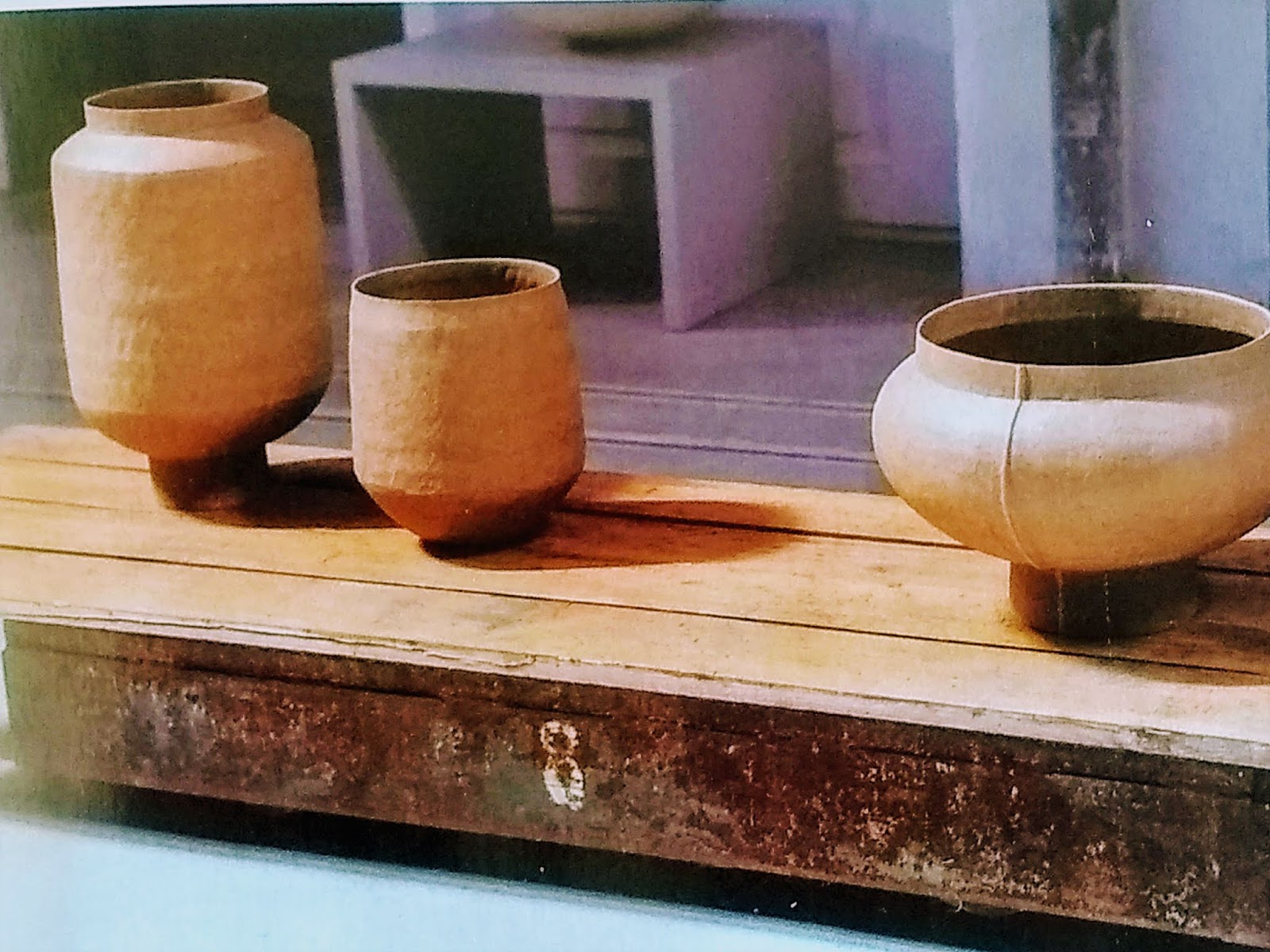
In the October Ceramics Monthly, there's an article about Sylvie Enjalbert, by Lucie Brisson. That's usual; they often profile a potter/ceramic artist, or several, in an issue. But I found this article very moving.
She finds her life as a potter quite separate from her previous way of life. I am moved by the continuity. "In the early 2000s she was an avid mountaineer and paraglider living and working in the tourism industry in the Atacama desert of Northern Chile...a long-felt desire to be creative with her hands caught up with her and she found herself enrolled in a local pottery workshop where she learned coiling. Clay turned out to be a powerful encounter in the breathtaking, arid landscape of sand and adobe houses." She let herself follow an internal push to where she wants to go, then and since: "Now I keep getting closer and closer to who I think I am, thanks to clay." This is wonderful and inspiring, her intuitive openness and patience. Perhaps it didn't have to be clay that led her, but it is. For me, too.
I am moved by her quietness, the more so because I read the article after returning from a craft sale, which is social, noisy and oriented to selling. "'I came back to the basics: my hands, a few wooden tools, the quiet, the slow working pace. '" It is an achievement to keep that going in the modern world.
And "the sources for her work include 'all the hands that have made things before mine...This is what moves me. Humanity.'" Oh, yes.
""My working motions were short and tight." Given an opportunity to make big pots, "'Suddenly I opened up...Involving my whole body was such pleasure.'" She is still an athlete.
And I would call hers desert pots. It all connects, beautifully.
I like many of her pots, the minimalism, the beautiful lines.
And so I am moved by this description of her working and what she says about it. Is this really her, or am I projecting an image I like? I don't know. Her website is as quiet and private as she seems, and I've never met her. True or imagined, I find her story impressive and inspiring.
sylvie-enjalbert.com
Wednesday, October 30, 2019
Monday, October 14, 2019
Going to Escondido; Want to Come?
Hello.
On Sunday, October 20, I will be at the Grand Avenue Festival in Escondido, 9 to 5, on Grand Ave. between Broadway and Kalmia. Come stop for a seat and shade if you are there. This is my first time there,so I don't know what it is like. Looking forward to it. New pots, of course, and some old ones.
Monday, September 30, 2019
Eye Training
We all learn to make pottery as a handcraft, needing training for the makers' hands. True, of course. To the extent that it is also art, or that the potter wants to make beautiful pots, it takes eye training too.
These days I am watching nature's design work to train my eyes to see form, proportion, color combination...
I see beauty, but also a kind of inevitability. This plant can grow only this way, and has to produce only this beauty.
Perhaps pottery made in a tradition also must look as it comes out traditionally, and feel inevitable.
From Traditional West African Pottery Kuli Village, by Terry deBardelaben.
I work as a studio potter in the US, where it is all open-ended, where we can borrow from everyone who allows us to, where creativity and inventiveness are valued. How do we come up with pots that are so right they are inevitable? We need to develop a quality of seeing that sees rightness.
By Heesoo Lee. How did she see that edge?
I'm working on it.
What a pleasure.
These days I am watching nature's design work to train my eyes to see form, proportion, color combination...
I see beauty, but also a kind of inevitability. This plant can grow only this way, and has to produce only this beauty.
Perhaps pottery made in a tradition also must look as it comes out traditionally, and feel inevitable.
From Traditional West African Pottery Kuli Village, by Terry deBardelaben.
I work as a studio potter in the US, where it is all open-ended, where we can borrow from everyone who allows us to, where creativity and inventiveness are valued. How do we come up with pots that are so right they are inevitable? We need to develop a quality of seeing that sees rightness.
By Heesoo Lee. How did she see that edge?
I'm working on it.
What a pleasure.
Friday, September 13, 2019
Kate Tremel, oh, wow!
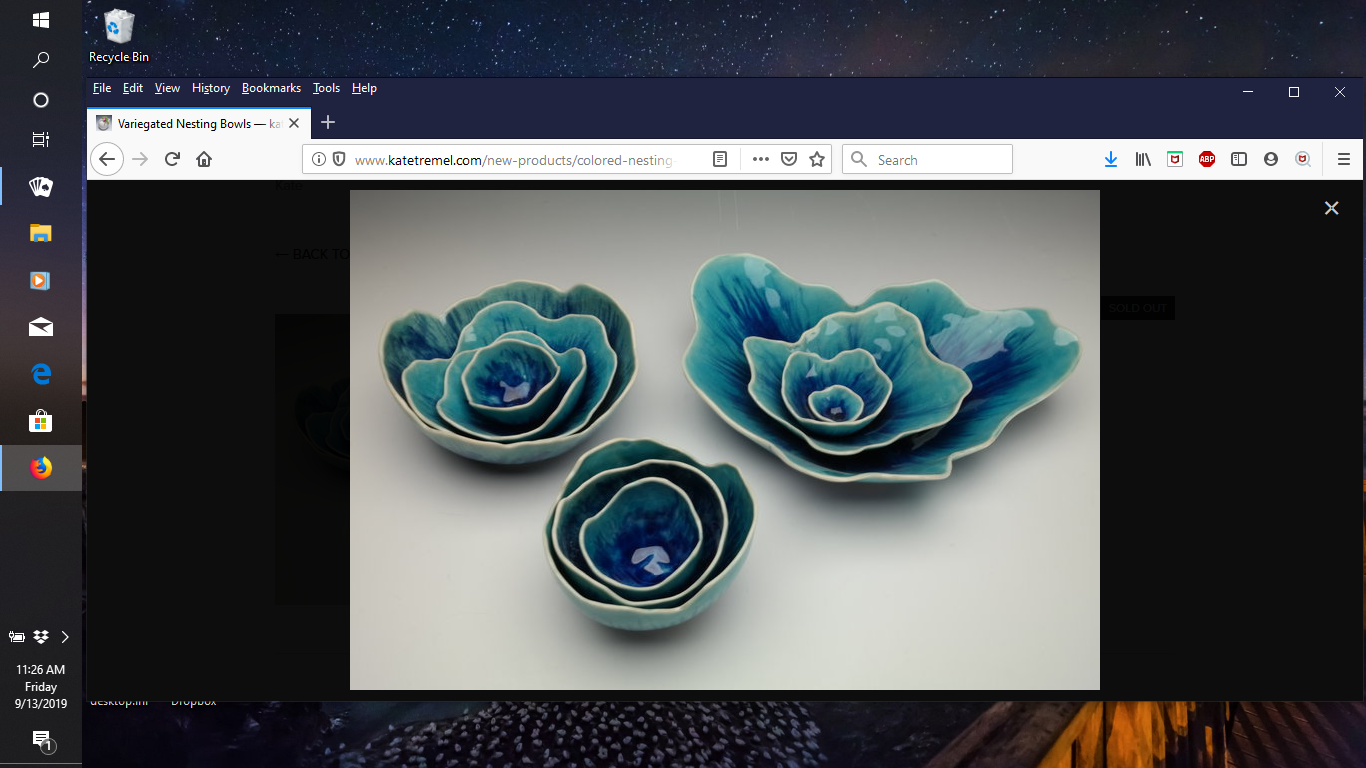
Look at this! I just stumbled over this advertising page, in the latest Ceramics Monthly. And I stopped reading, stopped breathing, and my eyes popped. Ooh!
This is a response to art, to the pure beauty of the thing. It's marvelous, the form, the thoughtful asymmetry, the contained looseness, the organic references, the quiet of it. Oh, and the technical quality.
Who would check if it is a functional pot? But that is what she makes, and the function matters to her. Even better.
It is in all ways to my taste, checks all my aesthetic boxes.
And then I like her attitude towards making pottery (quotes from her website):
"My interest in the vessel is rooted in its relationship to the body...getting dirty is important."
"I have always liked the connection to the history of makers that ceramics affords."
"My fascination with forms in nature and the everyday...nature of pottery provides me with the inspiration for a quiet meditation on the beauty of simple things."
Yes!! Check it out. katetremel.com
Thursday, August 29, 2019
Of Course Salt and Pepper Shakers are Cute!
I bought this one several months ago, from Ely, in Heraklion, in Crete.
Definitely cute, and oh, wow, the cork doesn't have to be on the bottom. That has put me off making shakers: how do I know how far the cork will stick out, to make a bottom that sits flat? Clearly, I made myself unnecessary difficulty with that idea.
Since then, I've made several others. They are just out of the firing and available to try.
Aah, they work. That's fun with something new. My cutest are definitely the accidental ghosts.
I didn't realize they were people until I made the pouring holes and saw faces. Ghosts in sheets, of course, and I glazed them white.
But Ely's is best. The cork as flirty tail wins the cuteness contest.
Definitely cute, and oh, wow, the cork doesn't have to be on the bottom. That has put me off making shakers: how do I know how far the cork will stick out, to make a bottom that sits flat? Clearly, I made myself unnecessary difficulty with that idea.
Since then, I've made several others. They are just out of the firing and available to try.
Aah, they work. That's fun with something new. My cutest are definitely the accidental ghosts.
I didn't realize they were people until I made the pouring holes and saw faces. Ghosts in sheets, of course, and I glazed them white.
But Ely's is best. The cork as flirty tail wins the cuteness contest.
Thursday, August 8, 2019
Art in the Village
as well as everywhere else.
Hello.
I'll be at Art in the Village on Sunday, in Carlsbad. Stop by if you like. There's lots to see!
That's Grand Avenue, downtown Carlsbad, cool and coastal. I'll offer you a chair in the shade.
Hello.
I'll be at Art in the Village on Sunday, in Carlsbad. Stop by if you like. There's lots to see!
That's Grand Avenue, downtown Carlsbad, cool and coastal. I'll offer you a chair in the shade.
Sunday, July 28, 2019
Copying Ancient Greece
In the archeology museum in Heraklion, Crete, I saw this pitcher. I don't remember how old it is, but certainly from some time in ancient Greece. Could I make it, or a reasonable approximation?
It's a technical challenge, to try to reconstruct what someone did, just from a side view on a museum shelf. I can't call and ask the potter. It's also an effort to walk in someone's shoes, to understand what he (probably) did and considered normal. And it's a try to make something I like.
This pitcher has a nice shape, a spout like nothing I've ever seen before, and requires a tricky cutting and assembly job. Ancient Greek pottery is famous for its painting, but also is very complex in form, and so in making. This is a relatively simple piece for them.
My first try was really about making the parts and assembling them. Nah, looks more like those Italian espresso pots.
So I measured the picture to get the proportions right and tried again.
Not quite right. I found it hard to get enough width near the base, after that neat lift, and then collar in enough for the "waist". The top is a bowl, but, again, the proportions are hard to produce. A lot is cut out for the shape of the top section, and for the spout.
I've always thought of and learned to make spouts that are a protruding angle. This is a cut out arc.
I had to make the pot to find out if it pours and keeps control. It does, very neatly, so long as you don't pour too fast; that lets the liquid flow around the spout as well. And will those points just break off easily?
The handle works better unglazed, like the Greek pot. These days we make wider, flatter handles usually, with a rectangular, rather than round cross-section:
The round handle, with a glossy glaze, is really slippery, and the full pot is hard to hold.
A fun project. In some way, it's difficult -- they were skilled potters. In some ways it works fine, and offers an alternative to what we usually do. In other aspects, I prefer our way. Well, of course.
It's a technical challenge, to try to reconstruct what someone did, just from a side view on a museum shelf. I can't call and ask the potter. It's also an effort to walk in someone's shoes, to understand what he (probably) did and considered normal. And it's a try to make something I like.
This pitcher has a nice shape, a spout like nothing I've ever seen before, and requires a tricky cutting and assembly job. Ancient Greek pottery is famous for its painting, but also is very complex in form, and so in making. This is a relatively simple piece for them.
My first try was really about making the parts and assembling them. Nah, looks more like those Italian espresso pots.
So I measured the picture to get the proportions right and tried again.
Not quite right. I found it hard to get enough width near the base, after that neat lift, and then collar in enough for the "waist". The top is a bowl, but, again, the proportions are hard to produce. A lot is cut out for the shape of the top section, and for the spout.
I've always thought of and learned to make spouts that are a protruding angle. This is a cut out arc.
I had to make the pot to find out if it pours and keeps control. It does, very neatly, so long as you don't pour too fast; that lets the liquid flow around the spout as well. And will those points just break off easily?
The handle works better unglazed, like the Greek pot. These days we make wider, flatter handles usually, with a rectangular, rather than round cross-section:
The round handle, with a glossy glaze, is really slippery, and the full pot is hard to hold.
A fun project. In some way, it's difficult -- they were skilled potters. In some ways it works fine, and offers an alternative to what we usually do. In other aspects, I prefer our way. Well, of course.
Subscribe to:
Posts (Atom)